
Read the transcript
The middle of the screen (#thread) is the conversation: your messages, the
agent's replies, its thinking, every tool it ran and every file it edited, in the
order they happened.
Why you would use it
This is where you follow what the agent is doing and check what it did. On a phone it is also where you go back over a long turn — a command's output, the lines of an edit — without opening a terminal.
How to use it
Scroll the transcript (
#thread). It opens at the newest message.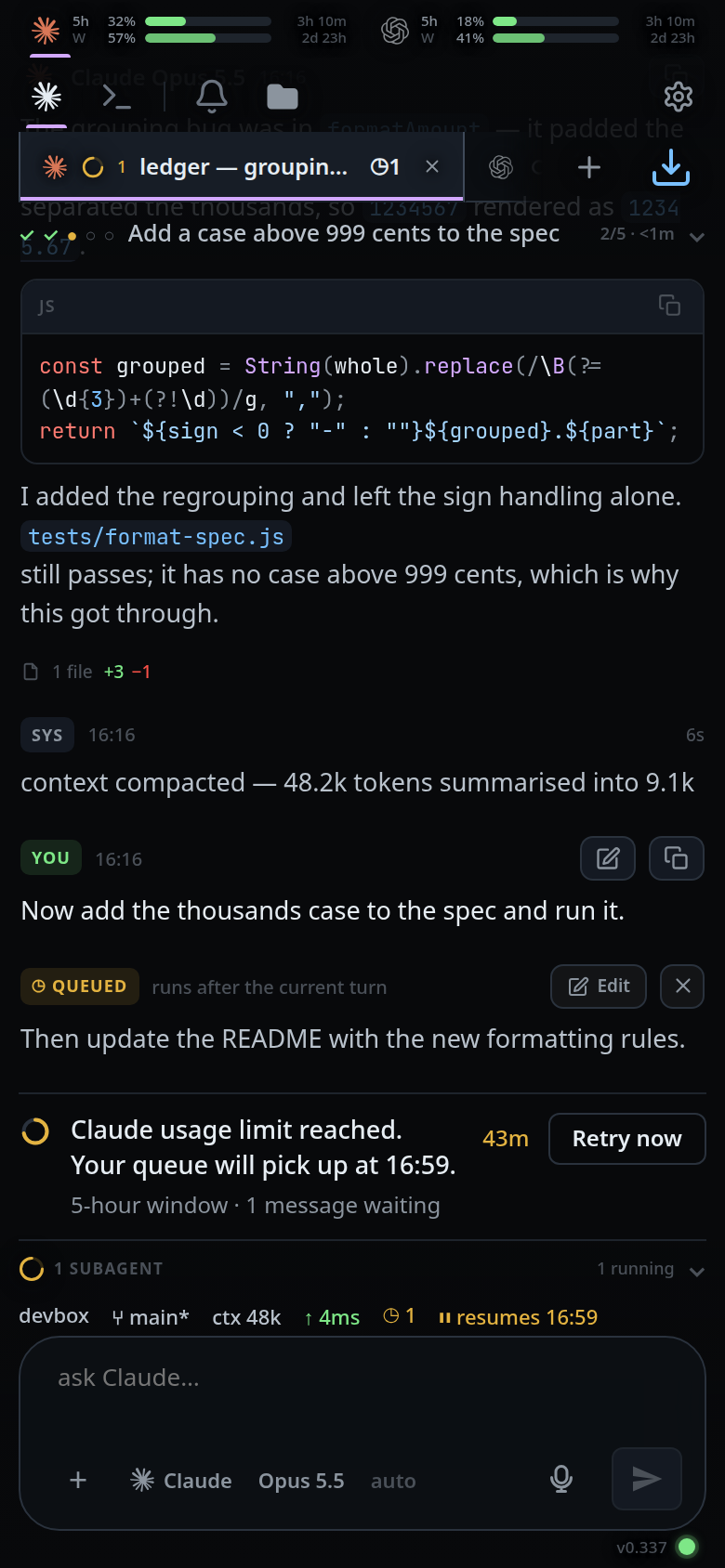
Tap a card that is clamped to open it in full; tap it again to fold it back.
Tap
▴ N earlierat the top to load more of the history.Tap the pencil on one of your own messages to pull that prompt back into the composer, or the copy icon to copy the text.
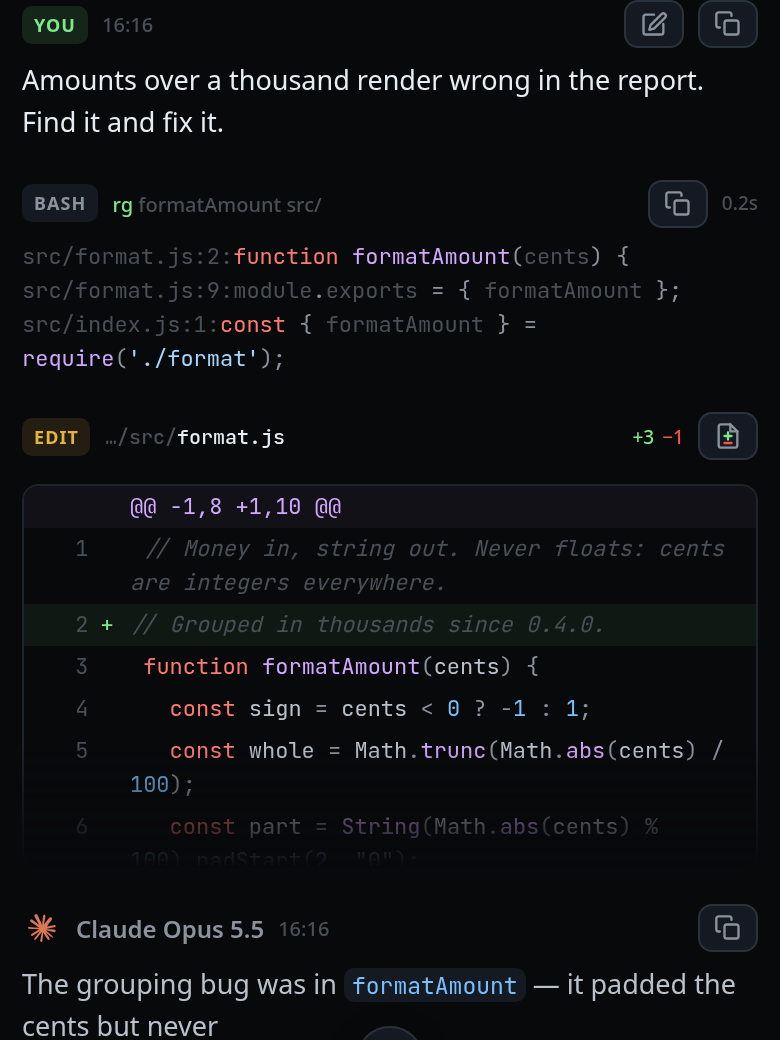
Tap the diff icon on an
EDITcard to open the full patch in the review sheet.
What you see
Every card carries a tag on the left:
| Tag | Card |
|---|---|
YOU |
a message you sent |
| the agent's logo plus its name and model | a reply, e.g. "Claude Opus 5" |
THINKING |
reasoning |
READ WRITE EDIT BASH SEARCH WEB SUBAGENT PLAN THINK TOOL |
a tool call, named from the tool |
EDIT plus a file path and +N −N |
a file the agent changed |
SYS |
VCode talking, e.g. context compacted |
NEEDS YOU |
an approval request |
◷ QUEUED / ◷ OUTBOX |
a message waiting to be sent — queued or held offline |
Beside the tag: the time for a message, the command for a shell tool (coloured
as shell), the file path for a read or an edit. On the right: how long the call
took (1.4s), … while it is still running, or the added and removed line
counts on an edit.
A tool card that is still running says running…. An edit card shows the first
8 lines of its patch until you open it.
Long cards are clamped — tool output over 8 lines or 700 characters, diffs over 8 lines or 1200 characters, anything else over 22 lines or 1600 characters. The last card in the thread is exempt when it is the reply itself, so the answer is never hidden behind a tap. Tapping a link, inline code, a code block or a table inside a card does not fold the card.
A turn that changed files gets a footer under its last reply: a file icon, N files and the totals. Tapping it opens
the list of files.
Cards that inform nobody are hidden: empty wait and ToolSearch polls,
TaskCreate and TaskUpdate calls, one-word subagent acknowledgements, and
"The file … has been updated successfully" under an Edit or Write. Errors
and running calls are never hidden.
The cog's Transcript group sets how much of each thinking, tool, edit and system card shows: in full, on one line, grouped or hidden. See stream-detail-levels.
Limits and known gaps
- A thread opens showing the newest 120 cards. Each
▴ N earliertap adds 400 more. A thread of 3,000 cards built in one pass stalls a phone for seconds, which is why the window exists. - Reasoning is shown only for agents that report it.
- Editing one of your prompts does not rewrite history: the original card stays, because the agent's side effects already happened.
/clearempties the transcript on screen. The log on disk is untouched, but the cards do not come back.
Related
- activity-line — what the card at the bottom shows while the agent works
- stream-detail-levels — show thinking, tool calls, edits and notes on one line, grouped or not at all
- copy-from-the-transcript — getting text out of a card
- formatted-answers — how markdown and code are rendered
- jump-to-latest — getting back to the newest message
- page-through-the-transcript — PageUp and PageDown on a keyboard
- plan-strip — the band of steps above these cards
- subagents-strip — the strip below them
- diff-review-sheet — the sheet the diff icon opens
- turn-changes — the file list behind the footer
- manage-queued-messages — the
◷ QUEUEDcards - approvals-are-bypassed — why
NEEDS YOUnever appears - icon-legend — what every glyph on a card means