
Choose how much of each step shows
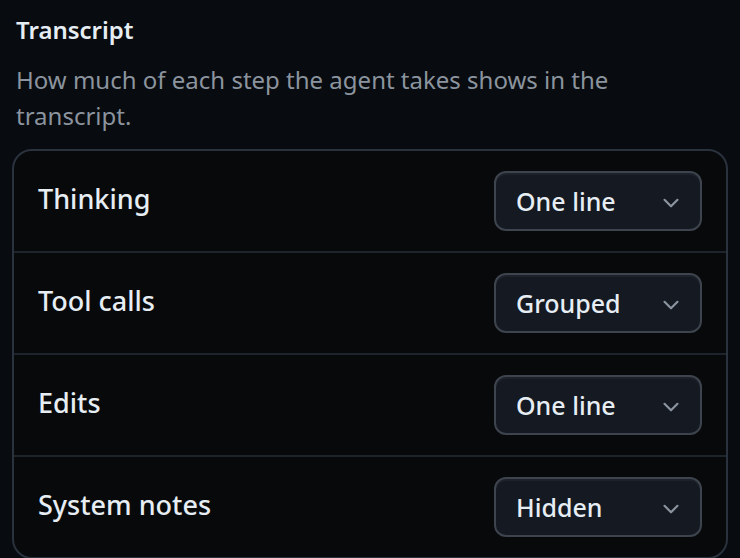
The settings sheet sets how much of each step the agent takes shows in the transcript: thinking, tool calls, edits and system notes. Each can show in full, on one line, grouped with its neighbours, or not at all.
Why you would use it
A long turn fills the phone screen with command output and patches, and the reply you came for sits below all of it. Put tool calls on one line or in groups and you see the steps as a list; tap one when you want its output.
How to use it
Tap the cog (
#settings-open).Find the Transcript group (
#settings-stream). Each type is a row: its name on the left, a box showing its level on the right.Tap a box to open its list, and tap a level. The current level has a green check. With a keyboard, the arrow keys,
HomeandEndmove through the list,EnterorSpacepicks, andEscapeshuts it. The boxes are:Thinking(#stream-thinking)Tool calls(#stream-tools)Edits(#stream-edits)System notes(#stream-system)
Close the sheet. The transcript redraws at the new level as soon as the pick saves, and so does every split pane.
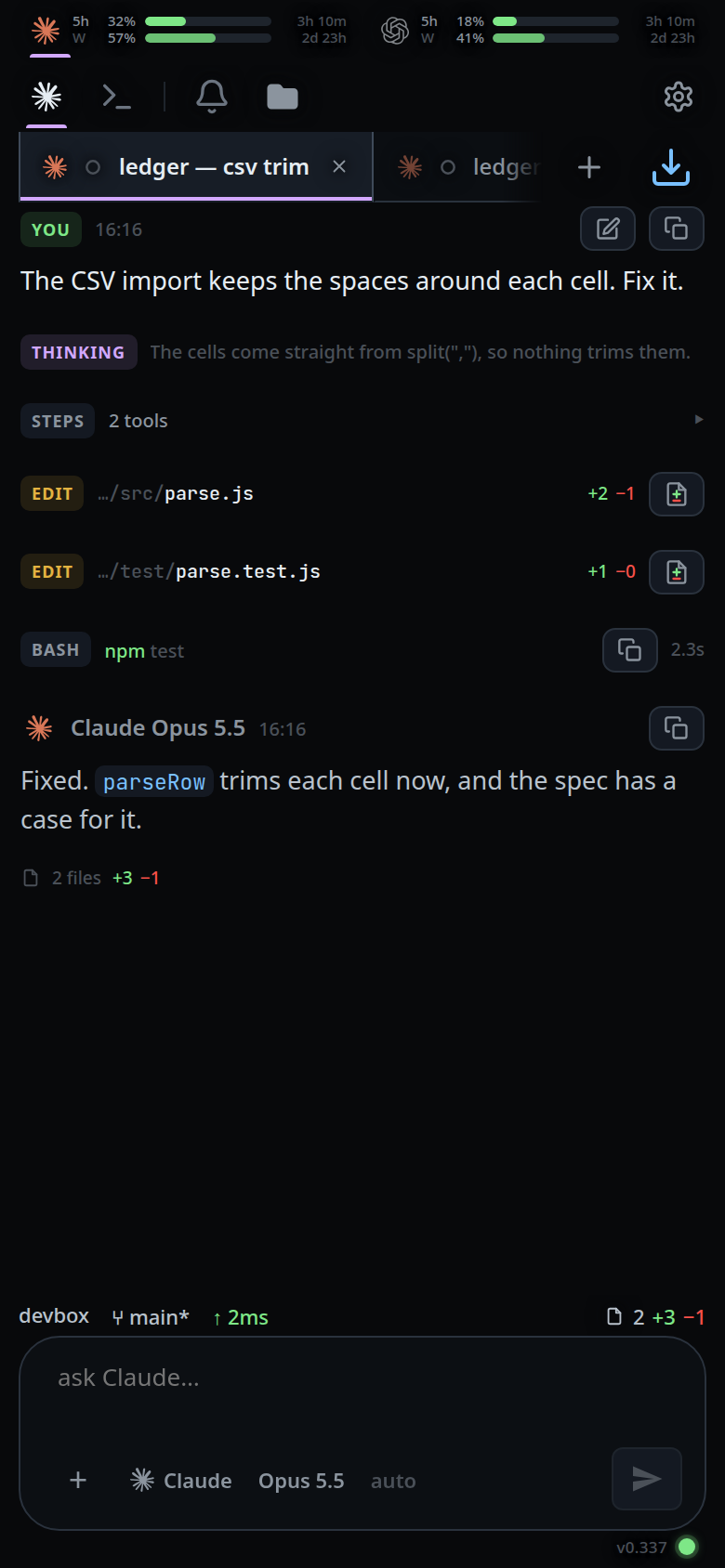
Tap a one-line card to open it in full; tap it again to put it back on one line.
Tap a
STEPSrow to open it. Its steps show below it, one line each. Tap the row again to fold them away.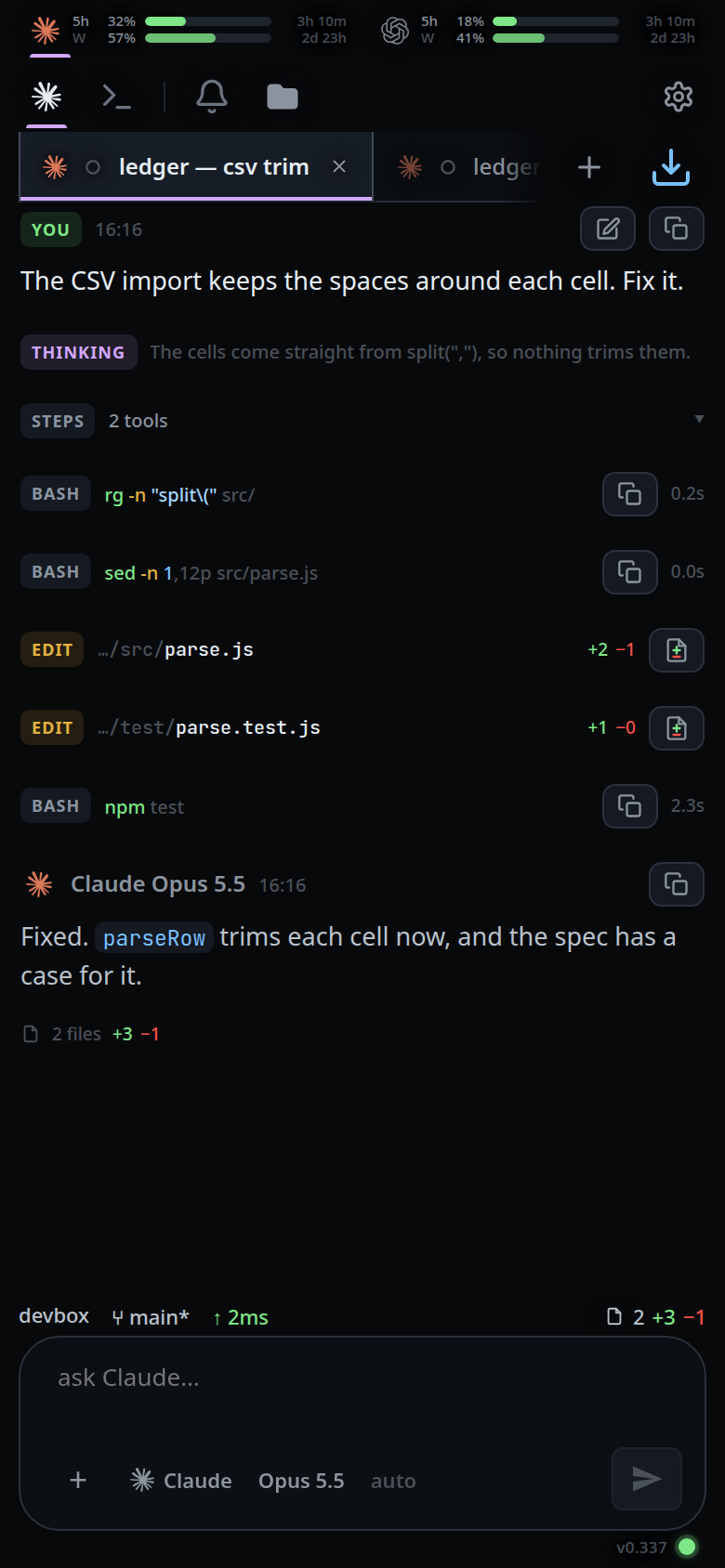
What you see
Each box offers four levels:
| Label | What the transcript shows |
|---|---|
Full |
the whole card, clamped when long, as it always was |
One line |
the card's head row alone: the tag, the command or file path, the counts and the time the call took. No output and no patch lines. A THINKING or SYS card shows the first line of its text instead of the time, cut with … |
Grouped |
a run of steps in a row folds into one STEPS row that counts them, e.g. 2 tools · 1 edit · 1 thinking |
Hidden |
nothing |
A run of grouped steps ends at any of your messages, any reply, or any step
shown at another level. A hidden step does not end a run. Different types can
share a group when both are set to Grouped. A run of one step shows as a
one-line card, not as a STEPS row.
The row counts each type in a fixed order: tools, edits, thinking, system. The
count is always written out: 1 tool, 3 tools, 1 edit, 1 thinking,
2 system. ▸ on the right means the row is folded; ▾ means it is open.
Some steps always show, whatever the level:
- a tool call that failed
- a tool call that is still running
- a system note that is a warning
At Grouped or Hidden these show as one-line cards and end the run they sit
in. At Full they stay full.
Your messages and the agent's replies always show in full.
While a save is on its way the right end of the group's title reads Saving…,
then a green check and Saved. A refused save puts the select back to what the
server holds and shows the error there in red and in a toast.
Options and settings
| Option | Default | What it changes |
|---|---|---|
Thinking (stream.thinking) |
Full |
THINKING cards |
Tool calls (stream.tools) |
Full |
tool cards: BASH, READ, EDIT tool calls, SEARCH and the rest |
Edits (stream.edits) |
Full |
the EDIT cards with a patch and +N −N |
System notes (stream.system) |
Full |
SYS cards |
The values stored are full, line, group and hidden. A box that never
changes them shows the transcript it always did.
Limits and known gaps
- The setting is the box's, in
settings.json, so every phone and browser signed in to it gets the same levels. Each browser also keeps the last levels it saw, so a thread opens at them straight away, and offline it uses them until the box answers again. - The history window counts rows at these levels, so a
STEPSrow counts as one toward the newest 120 a thread opens with. An open group still counts as one: its steps show with it and push nothing else out of the window. - A long card you opened at
Fullstays open if you then switch its type toOne line, until you tap it. - A
STEPSrow does not show the time its steps took.
Related
- read-the-transcript — the cards these levels apply to
- tab-colours — the Tabs group just above this one in the settings sheet
- toasts — where a refused save is reported