
Browse the thread's folder
A file tree of the folder the thread runs in. Folders open in place, files open in the viewer, and a row's menu makes, renames and deletes files. Nothing above the thread's folder is reachable.
Why you would use it
The agent says it changed lib/runner.js and you want to see the file before you
answer. Or you are picking up a thread on a phone and want to know what is in the
repository at all. The explorer gives you the tree without leaving the thread.
How to use it
Tap the folder button in the mobile icon rail (
#files-open), or swipe in from the right edge of the screen. The panel (#explorer) slides in from the right. On a wide screen the same button sits in the top row, next to Notify.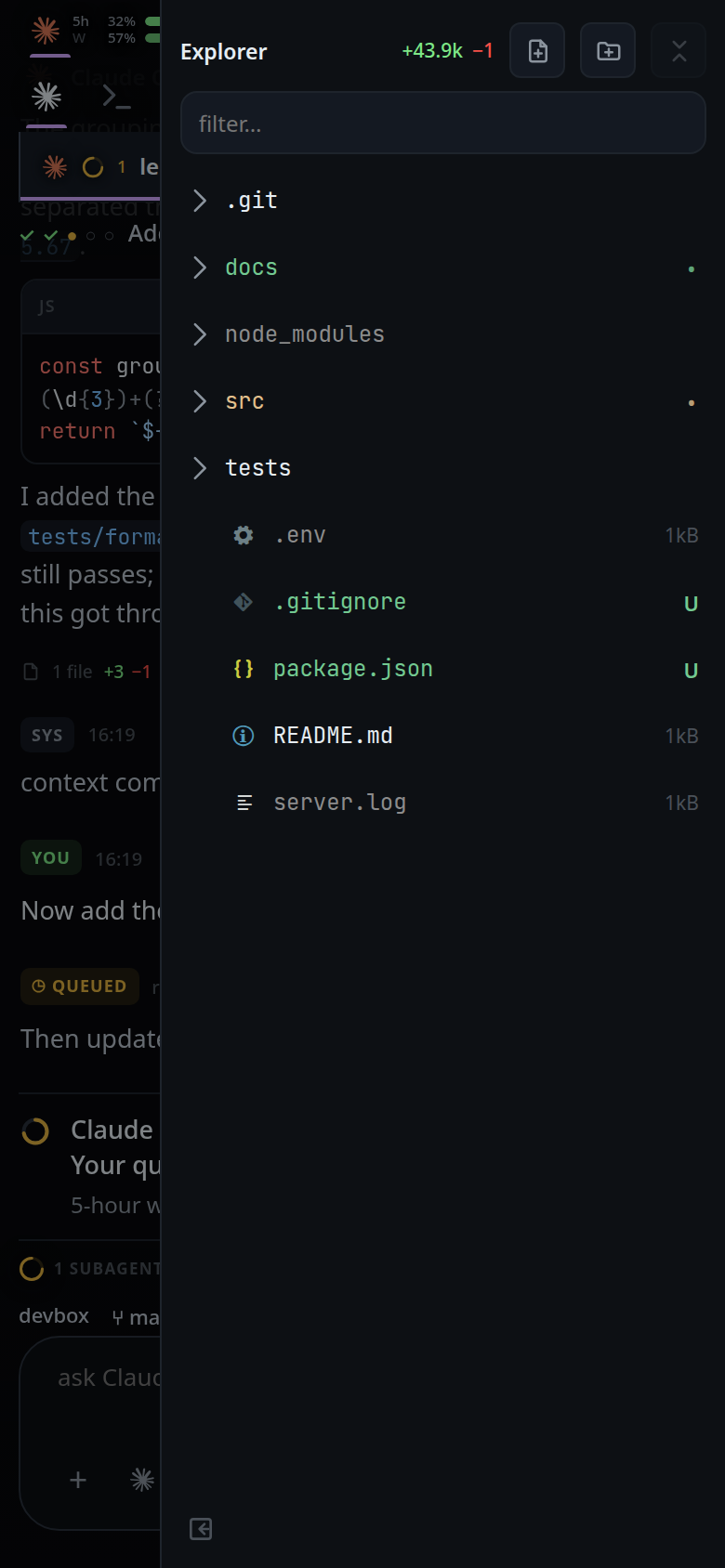
Tap a folder row. It expands in place under its own row; the chevron turns on the tap and
reading…shows under it until the listing lands.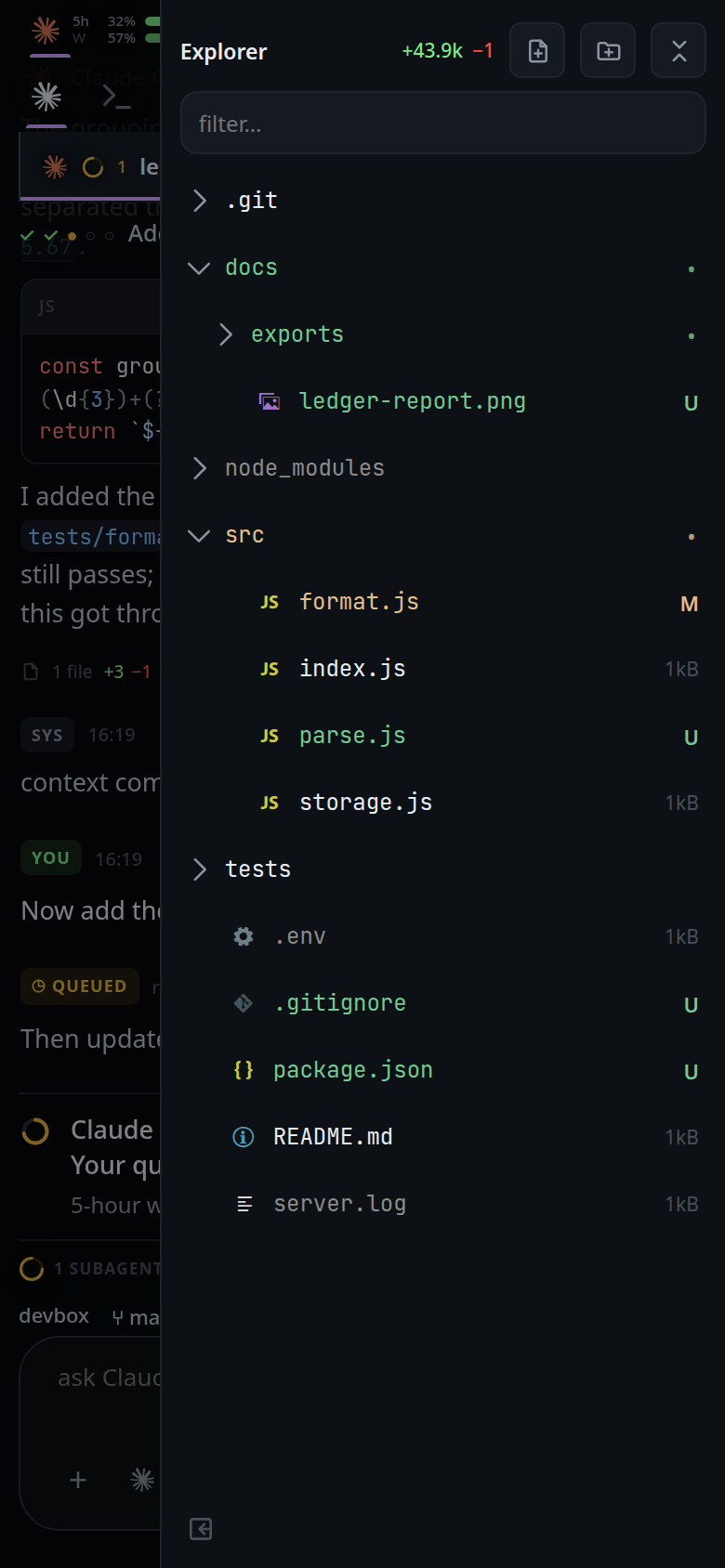
Tap the folder row again to close it. What it read is kept, so it reopens with no wait.
Tap a file row to open it in the viewer.
Right-click a row, or hold a finger on it, for New file, New folder, Rename and Delete. The New file (
#explorer-new-file) and New folder (#explorer-new-folder) buttons in the head make one at the top. See manage-files.Tap the collapse button (
#explorer-collapse, "Collapse all") to shut every open folder at once. Nothing is re-read. With no folder open the button is dimmed and does nothing.Tap the small bottom-left Hide file explorer control (
#explorer-toggle) to close the panel. On a wide screen, the same control hides the docked column and remembers that choice; a slim rail (#explorer-rail) stays standing where the column stood — click it, or the folder button, to show the column again.On a phone or tablet, you can also close the panel with the phone's back button, by tapping the scrim outside it, or by swiping it back to the right edge.
What you see
- The header reads
Explorer(#explorer-path). Its title holds the whole path of the thread's folder; hover it on a desktop to see it. Beside it is the total of what changed under the folder (#explorer-delta). - Folders sort before files, then by name, case ignored.
- The rows look like VS Code's explorer with its default Seti icon theme. A
folder is a thin chevron and its name, no icon; the chevron points right and
turns down when the folder is open. A file has an empty chevron column, then
its Seti icon in the icon's own colour:
{}in yellow for a.jsonfile,!in purple for YAML, a gear for.envand.env.*, a blueiforREADME.md, the Docker whale for aDockerfileor a compose file, a picture for an image. - A file row shows its size on the right. A changed file shows its letter there instead, and its name takes a colour: see explorer-change-counts. Folders show no size.
- A symlink row carries an arrow (
→). A link to a folder expands like a folder; a link to a file opens in the viewer. - A folder being read for the first time shows
reading…. An empty one showsempty. A folder that cannot be read shows the reason in place of its rows and the same message pops up as a toast. - The small bottom-left panel control hides the explorer. On a wide screen a slim rail stays where the column stood; clicking the rail or the folder button brings the column back, and the phone or tablet opens it as an overlay again.
- After 500 entries a
Load morerow appears at the folder's own depth; tapping it appends the next page. - Dotfiles,
node_modulesand.gitare ordinary rows you can open. What git ignores is drawn grey. - On a phone a row is 36px tall for a thumb. On a wide screen it takes VS Code's sizes: 22px rows, 8px of indent a level, a 16px chevron column and a 16px icon column.
Limits and known gaps
- There is no upload, copy or drag and drop. Create, rename and delete are in the row menu; see manage-files.
- The root is the thread's folder. A path with
..in it, an absolute path, or a symlink that lands outside the folder is refused: "path escapes the folder". - A symlink is judged by where it resolves to, not by its name.
- A page is 500 entries. A folder with more is paged by
Load more. - Anything that is not a regular file or a folder (a FIFO, a socket, a device) is listed but refused when opened: "that is not a regular file".
- Two tabs on the same folder do not share a listing. Switching tabs, or changing a thread's folder, clears the panel and re-reads the root.
- Listings are never cached and never stored offline. With no connection the panel shows the failure and nothing else.
Related
- find-a-file — when the tree is too deep to walk
- file-viewer — what a file row opens
- manage-files — the row menu: new, rename, delete
- explorer-change-counts — the letters and colours on changed and ignored rows
- thread-working-folder — the folder the tree is rooted at
- wide-layout — where the panel becomes a docked column
- back-button — what back closes first