
Choose where your typing goes — Agent or Shell
Two chips at the top of the screen decide who reads what you type: the agent, or the shell pane.
Why you would use it
The same box serves both, so before typing you want to know where it lands. The chips say, and the placeholder says again.
How to use it
On a phone the chips are in the strip
#send-modes, in the row under the usage meters at the top of the screen — left of Notify. The two-row shell keypad stays in the bottom band while Shell mode is selected. On a wide screen that strip is not shown: the pair sits in each pane's header instead (.pane-modes), and is that pane's own.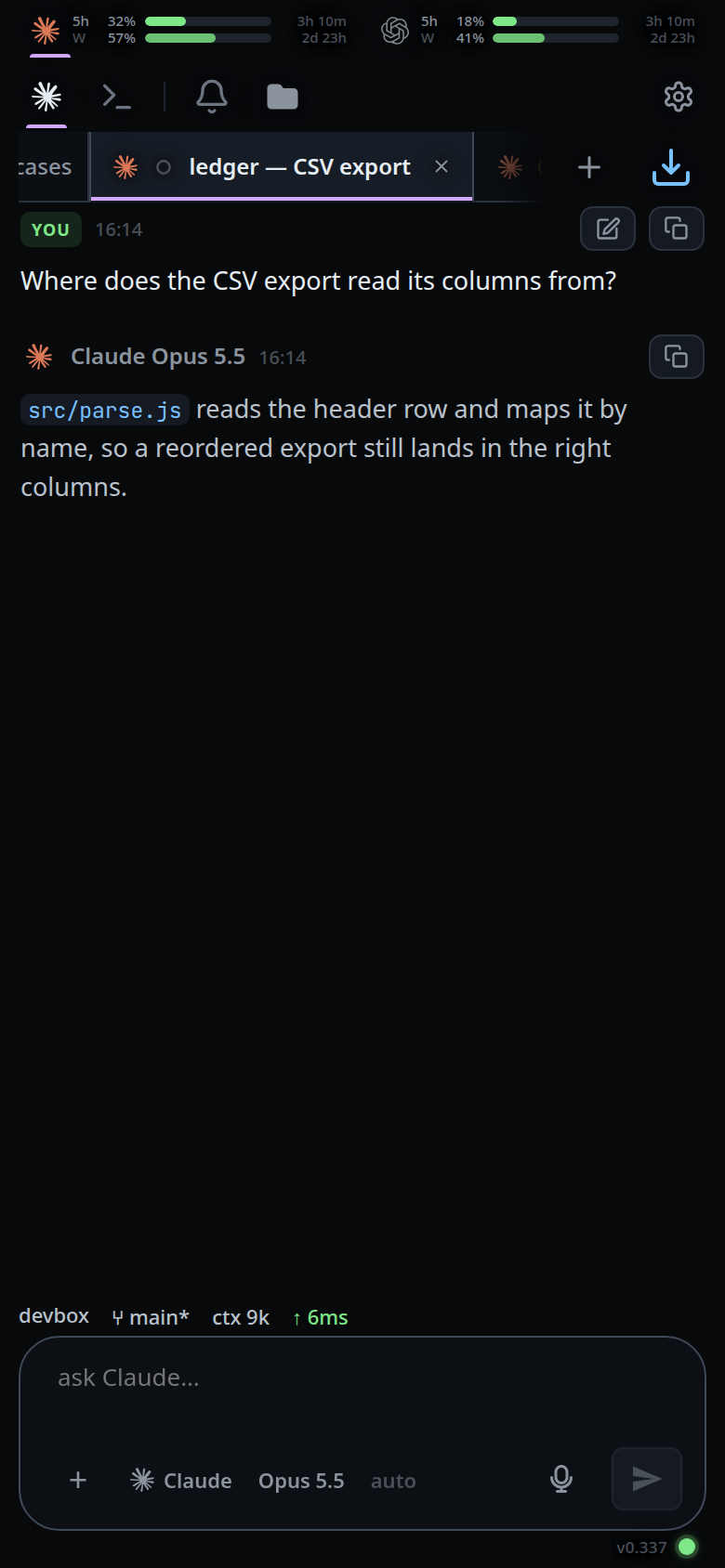
Agent wears the agent's own mark. Shell wears a terminal icon. Neither is labelled on screen: the names are in the tooltip and the aria-label, and the selected one is brighter with a bar under it.

Tap one. Tapping Shell swaps the transcript out for the shell pane. Clicking Shell in a pane header focuses that pane first, then switches it.
Tap the × on the shell pane's header (
#panel-close) to go back to Agent.
What you see
The placeholder in #draft follows the mode and the state:
| State | Placeholder |
|---|---|
| Shell mode | run a shell command… |
| Agent idle | ask Claude… — the agent's own name |
| Agent mid-turn, steering possible | use the wheel to steer |
| Agent mid-turn, steering not possible | queues until this turn ends |
The selected chip is brighter and reports aria-pressed="true".
On a wide frame the mode belongs to the pane. sendMode is the focused pane's,
so moving the focus to another pane puts the composer back in the mode that pane
was left in, and an unfocused pane's header shows the mode it will come back to
rather than the composer's. A pane in Shell mode shows its shell inside its own
box; the other panes keep their conversations.
Limits and known gaps
- The slash menu does not open in Shell mode: there,
/usris a path. - The steering wheel (
#steer) is hidden in Shell mode. - Steering used to be a third mode here. It is not one any more — it only ever applies to the message being sent right now, so it is a button beside send.
- A handoff to another agent forces the mode back to Agent, so the brief is not typed into tmux.
- A dev auto-reload remembers the mode; Shell mode reopens after it.
- The per-pane choice is not kept anywhere. A reload comes back in one mode, the one the composer reopens in, and every pane starts from it.
- All the panes share one tmux session, so two panes in Shell mode are looking at the same shell.
Related
- send-a-message — the Agent path
- bang-command — one command without leaving Agent mode or the transcript
- shell-mode — the pane Shell mode opens
- queue-or-steer — the wheel the placeholder mentions
- shell-keys — the keypad shown in Shell mode
- icon-legend — what each mark in the strip means
- wide-layout — the pane headers the pair moves into